
Every run feels hard. You finish breathless, legs heavy, wondering why everyone else seems to manage. Three weeks in, and nothing has clicked.
That feeling is not a sign you are failing. It is almost always a sign you are running too fast, too far, or too soon.
The fix is rarely to try harder. It is to do less, and do it at the right pace.
The most common reason running feels hard
Most beginners start at a pace that feels honest but sits in entirely the wrong zone. The effort is obvious, the breathing is elevated, and it seems like something productive must be happening.
The problem is that this middle pace is physiologically awkward. It is too fast to build your aerobic base efficiently, and too slow to produce the gains that hard efforts buy. Exercise physiologists call it the grey zone, and it is where most new runners quietly get stuck.
Running in the grey zone does not build fitness. It builds fatigue.
The answer is to slow down, often by more than feels comfortable. At the right easy pace, you can hold a full conversation. Speak a sentence out loud without stopping. If you cannot finish it, you are going too fast.
For a full explanation of why the easy pace works, running pace for beginners covers the physiology and what the right effort actually feels like.
The talk test
The conversation test is the simplest calibration tool available, and it costs nothing.
If you can speak a full sentence without gasping, your pace is right. If you are struggling to get a few words out, ease off.
For many new runners this pace feels embarrassingly slow. That reaction is useful information. Slow means the aerobic system is building. Faster means it is burning through what is already there, not adding to it.
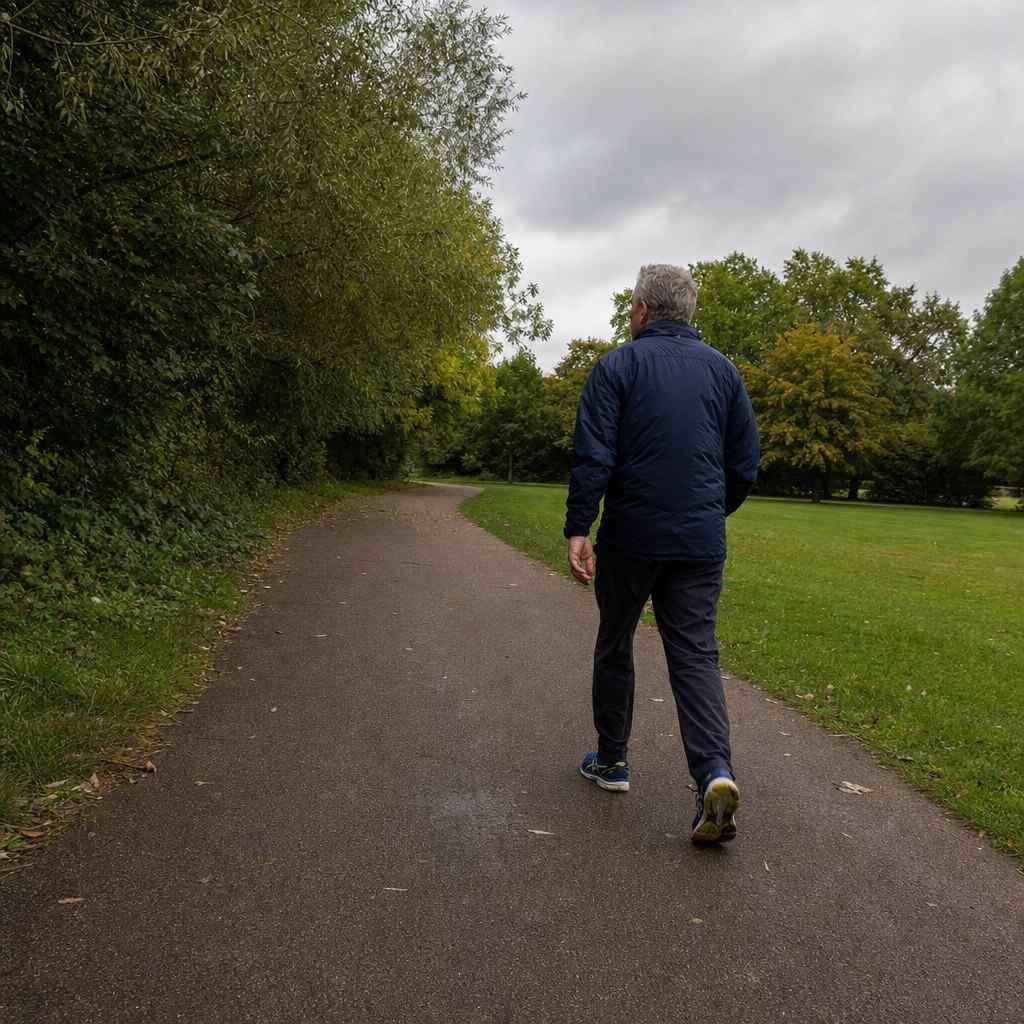
On a grey, damp Saturday morning, running at a pace where you could actually chat to someone alongside you is doing more work than the hard red-faced effort ever did.
Walk more, not less

Walk/run intervals are not a compromise while you wait to become a proper runner. They are the recommended method for beginners, and the answer to a run that feels too hard is almost always to walk more within it.
Walk/run intervals are not a compromise while you wait to become a proper runner. They are the recommended method, and the answer to a run that feels too hard is almost always to walk more.
If one minute of running and two minutes of walking is too much, make it one minute of running and three minutes of walking. Or thirty seconds of running and three minutes of walking. There is no rule about the ratio. What matters is that the running minutes stay easy enough to be sustainable.
Shortening the running intervals is not going backwards. It is finding the level where adaptation actually happens.
The how to start running guide sets out the walk/run structure from the beginning if you want to revisit the basics.
Too many days, too little recovery
Running three days in a row in the first month is usually too much. After 50 especially, the structural adaptation that makes running sustainable happens between sessions, not during them.
The rest days are where the work lands. Muscle, tendon, and bone all rebuild during recovery. Skipping it means going into the next session on a system that has not finished adapting from the last one.
Two sessions per week is enough to make real progress in the early going. Two rest days between sessions is better than one. If each run still feels as hard as the first, the schedule is probably too full.
Breathlessness gets better
Early breathlessness is one of the most discouraging parts of starting out, and it is also the part that improves fastest.
The cardiovascular system adapts quickly to a new training stimulus. Within two to three weeks of consistent easy running, the same effort will feel noticeably easier. That is not willpower or getting used to the discomfort. That is the heart and lungs genuinely becoming more efficient.
Early breathlessness is not a signal that running is not for you. It is the signal that adaptation has started.
If you are still finishing every session completely winded after a month of consistent, easy-paced running, the pace is still too fast.
Managing expectations
Starting running at 50 or 60 is not the same as starting at 25. Recovery takes longer, connective tissue adapts more slowly, and the early weeks can feel harder than they look from the outside.
None of that means running is out of reach. It means the timeline is different. Starting running after 50 covers the physiology honestly, including what changes and what does not.
Comparing your progress to a younger version of yourself, or to other people at parkrun, is the fastest way to feel like you are behind. You are not behind. You are at week three of something that takes months to settle in.
The person walking the whole of a Saturday parkrun is not failing to run it. They are doing what works for them, at the pace they need, on the schedule their body can handle.
When “too hard” is a warning sign
Most of the time, a run that feels too hard is a training problem, not a medical one. But some signals are worth taking seriously.
Chest pain or pressure during a run warrants stopping and speaking to your GP before running again. The same applies to unusual dizziness or a feeling of faintness, breathlessness that is out of proportion to your effort, or an irregular heartbeat you can feel.
These are not common, but they are real. This is general information, not medical advice, so if you are concerned about any of these symptoms, speak to your GP.
Sharp pain in a joint, as distinct from general muscle tiredness, is also a reason to stop. For more on telling ordinary soreness from something that needs attention, what the research says about knees and running after 50 covers both.
Struggling does not mean failing
Fitness built from scratch takes time. The first month of running is genuinely hard for most people, even when the pace and structure are right. That is not a reflection of whether you are suited to it.
Most people who keep going find that the run they thought was impossible in week two becomes comfortable by week eight. The difficulty does not signal failure. It signals the start.
Walk more. Slow down. Rest properly. Stay consistent. That combination will do more than any amount of pushing through.