
Picture a grey Saturday morning. A few hundred people mill around a park café, clutching cups of tea, waiting for a volunteer with a megaphone to say a few words. Then they set off along a 5K (just over three miles) course. Some run hard from the front. Most run at a steady plod somewhere in the middle. A fair number walk.
That is a typical parkrun. No entry fee, no qualifying time, no pressure.
What parkrun actually is
A parkrun is free, happens every Saturday at 9am, and the only thing you need is a barcode.
It is not a race, even if some people treat it like one. It is a timed community event. You register once at parkrun.org.uk, print or save your personal barcode, and then turn up at any of the 800-plus UK locations whenever you like.
You show your barcode at the finish, and within a few hours a time appears on the parkrun website with your name against it.
Core Principle 1 from the site’s editorial standard: parkrun is the UK’s most beginner-friendly entry point, free, every Saturday, and completely walkable.
Registering before you go
Registration takes about five minutes online at parkrun.org.uk. Fill in your details, choose a home location, and a barcode is emailed to you.
Print it, or save it on your phone. Without the barcode, you can still run the course, but you will not get a recorded time. Bring it every time from then on.
You only ever register once. After that, the same barcode works at any parkrun in the world.
What happens on the day
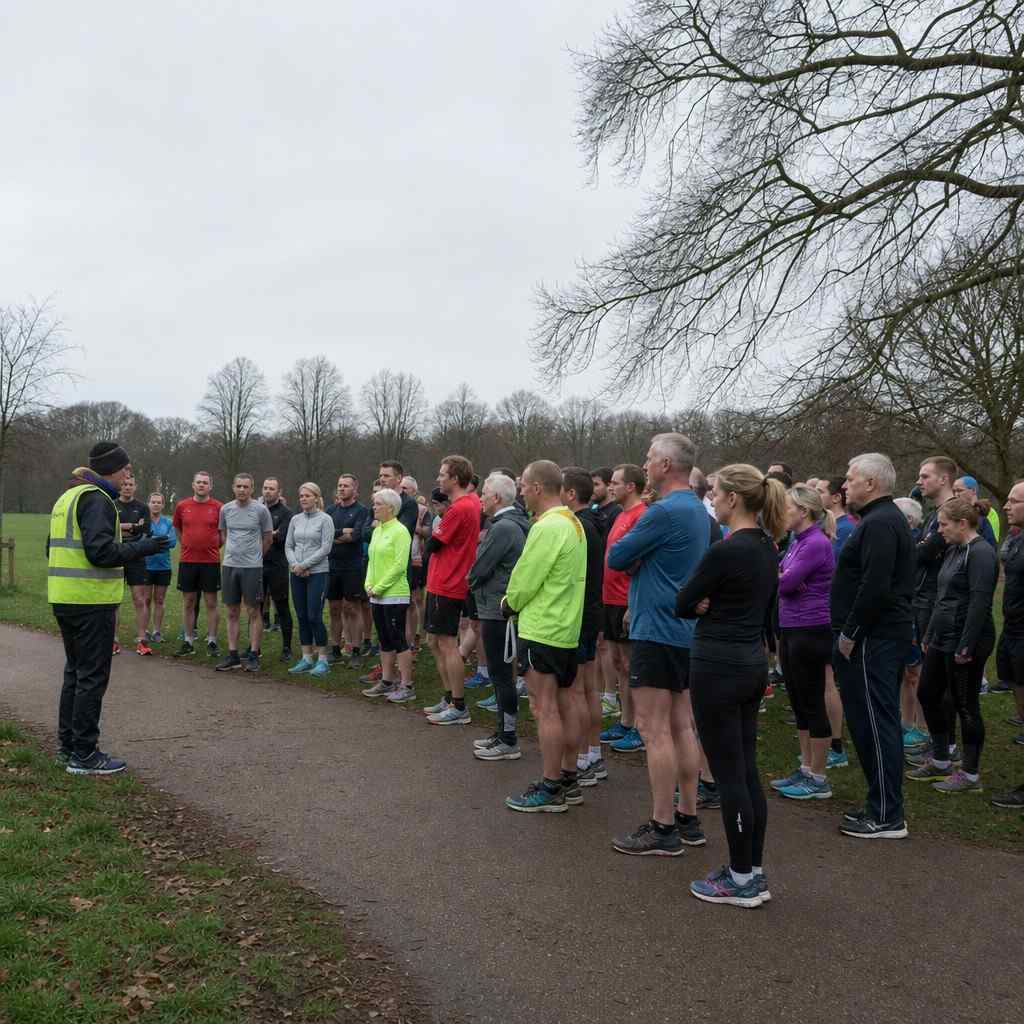
Arrive about ten minutes before 9am. There is usually a gathering near the start, and a run director gives a short briefing, especially welcoming first-timers and visitors.
New runners are always invited to introduce themselves at the start, and a regular volunteer often walks the course with them beforehand. You do not have to take up either offer, but they exist and they are not performative.
Then everyone sets off together. The fast runners are at the front in about thirty seconds. After that, the field strings out into whatever pace suits each person.
There is usually a gathering near the start, and a run director gives a short briefing, especially welcoming first-timers and visitors.
Marshals stand at the corners and junctions to point the way. You cannot really get lost, but on a large course or a first visit, seeing a friendly face at each turn helps.
At the finish, volunteers hand you a plastic token with your finish position. You then scan your personal barcode alongside the token. The pairing is what generates your time.
Walking is genuinely fine
This is not polite reassurance. Walking every step of a parkrun is a completely normal way to participate. Plenty of regulars do exactly that every week, including people who could run faster but prefer the walk.
According to parkrun’s own figures, a significant portion of participants walk or run-walk every event. The only pace that gets you a recorded time is the one that gets you across the finish line.
If you are following a walk/run training plan, a parkrun gives you a real route, proper distance markers, and a cheerful marshal at every corner. That is a better training environment than most people get from a solo session.
The tail walker
The last person to finish a parkrun is never last, because the tail walker is always behind them.
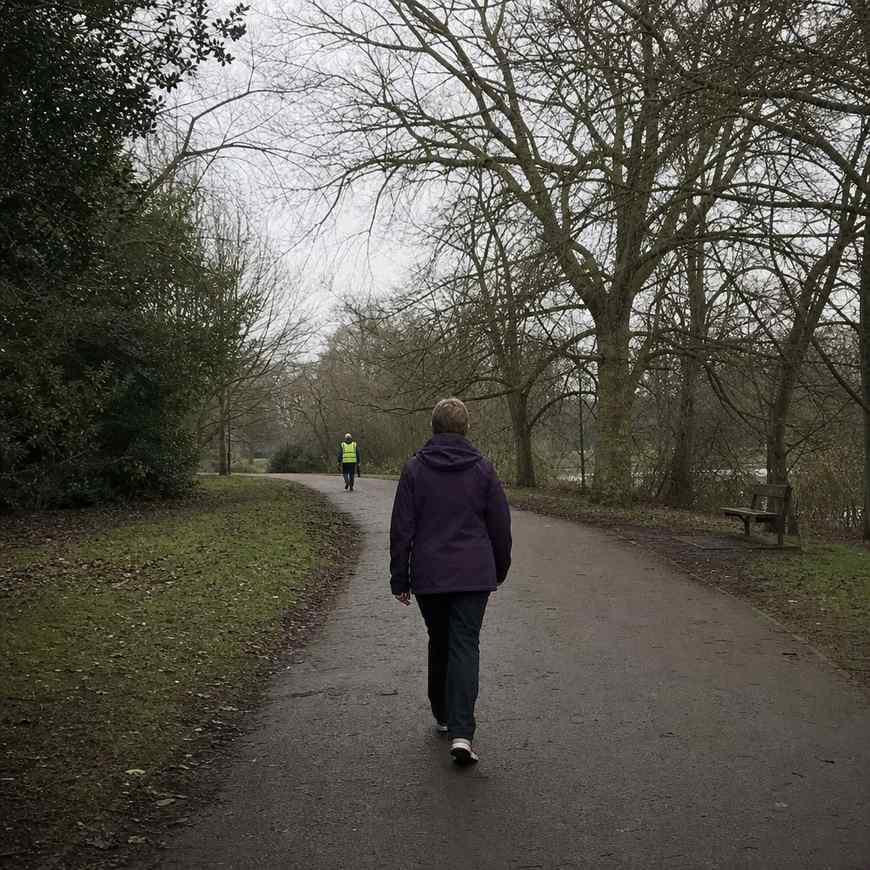
Every parkrun has a designated tail walker, a volunteer who sets off last and walks the whole course. Their job is to make sure no one is alone on the route and to close the event safely.
It means the field has no official back of the pack in the way competitive races do. You cannot be cut off, timed out, or made to feel you have held anyone up.
For someone doing their first parkrun at a cautious walk, knowing the tail walker is there tends to settle a specific kind of anxiety.
Who shows up
The field at most UK parkruns will surprise people who expect a start line full of competitive runners.
The 50 to 59 age group is one of the largest in the field at most UK events, most weeks. People in their 60s and 70s are a regular presence. Dog walkers, mothers with buggies, people who have never run a day in their life before that morning.
This is not a claim about the parkrun community being welcoming in the abstract. It is a description of what the field literally looks like on a typical Saturday.
Dog walkers, mothers with buggies, people who have never run a day in their life before that morning.
If you are nervous about being the slowest, or the least fit, or the only one who walks, the honest answer is that you are probably wrong on all three.
What to wear and bring
No special kit is needed.
Comfortable trainers, loose trousers or leggings, and a layer you can move in freely are enough. On a grey or wet morning, add a light jacket. Nothing else is required for your first visit.
If you want to start thinking about proper running shoes, getting fitted at a running shop is the advice worth following. Someone watching you walk can match the shoe to your stride in a way no online quiz can. For the reasoning behind that, how to start running covers it fully.
The one thing to bring is your barcode. Without it you run without a time.
parkrun is not a running club
This matters because running clubs, however friendly, carry a specific social expectation. You are expected to run, to keep up with a group, to come back regularly.
A parkrun carries none of those expectations. You can go once and never again. You can walk. You can show up in whatever shape you are in that week.
For someone thinking about starting running after 50, parkrun functions as a low-pressure test run, literally and figuratively. You get a distance, a time, and a sense of how your body handles 5K on real ground, all without any commitment beyond turning up.
It is also the point where a lot of people realise that the version of this event they had built up in their head was considerably more intimidating than the real thing.
Before your first parkrun
A few weeks of walk/run sessions beforehand helps, but they are not compulsory. If you want a structure that leads neatly to a first parkrun, how to start running with no experience is the place to start.
Register at parkrun.org.uk, print your barcode, and turn up ten minutes before nine. That is the complete list of requirements.
If your knees have been a source of worry, the research is more reassuring than most people expect. Will running ruin your knees after 50 covers what the evidence actually shows.
This is general information, not medical advice. If you have a health condition or joint concern, a word with your GP before your first event is always sensible.