
The first run is not a revelation. Your legs feel heavy, your breathing is harder than you expected, and two minutes of jogging leaves you wondering whether something is wrong with you. Nothing is wrong. That is exactly what week one feels like for most people over 50 who are starting from scratch.
Month one is about adaptation, not achievement. Progress is real, but it does not move in a straight line, and it does not show up as distance or pace.
What week one actually feels like
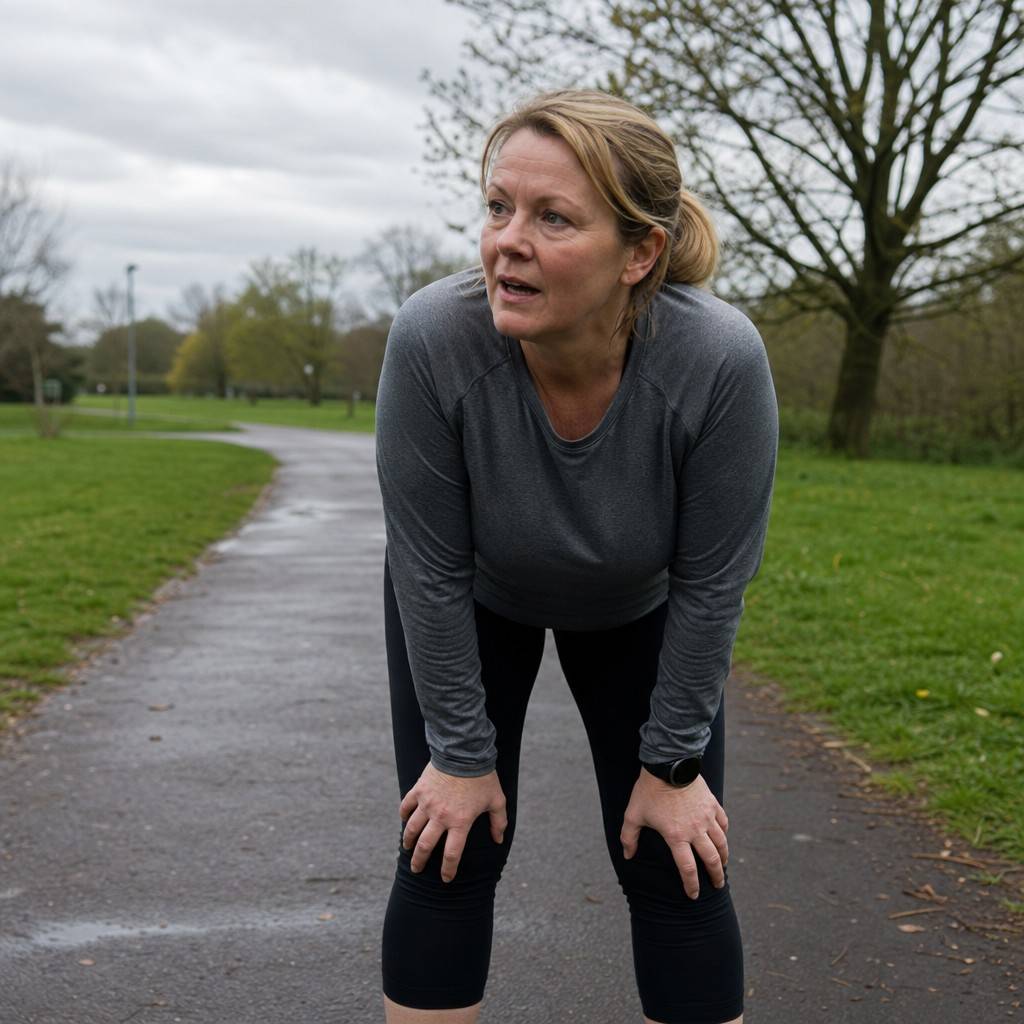
The honest answer: harder than you hoped, but manageable if you have the right structure.
Most beginners over 50 start with walk/run intervals, and that is the right approach. One minute of easy running followed by two minutes of walking, repeated for twenty to thirty minutes, is a reasonable first session. The NHS Couch to 5K is built on exactly this pattern, and no session in the early weeks asks for anything longer.
Hold each running minute slow enough that you could finish a sentence out loud. If you cannot, you are going too fast. Ease off until you can.
The breathlessness in week one is real and normal. Your cardiovascular system is being asked to do something it has not done in years, possibly ever. It responds, but it needs time.
The breathlessness in week one is real and normal. Your cardiovascular system is being asked to do something it has not done in years, and it responds, but it needs time.
Walk/run intervals are not a temporary compromise while you build up to “real” running. They are the recommended method, full stop. There is no rule that says you must run continuously, and month one is absolutely not the moment to test whether you can.
Post-run soreness and what it means
After your first session or two, you will almost certainly feel it in your legs the next day. A dull ache in the quadriceps or calves, worse when you walk downstairs, easing as the day goes on. That is delayed onset muscle soreness, and it is ordinary. It is your muscles responding to an unfamiliar load.
This is general information, not medical advice, so if you are concerned about any pain, speak to your GP. For the difference between normal soreness and something worth paying attention to, see what post-run ache is normal and what is a warning sign.
The good news is that this soreness diminishes as the weeks pass. By week three or four, the same session that left you stiff the following morning will leave you barely aware you ran. That shift is one of the clearest signs that your body is adapting. It is also one of the better reasons to keep going through the early discomfort.
The urge to do more, and why to resist it

Somewhere around week two, many beginners feel good enough to want to push harder. An extra session, a longer run, a slightly faster pace. This is the point where most first-timers run into trouble, and it is worth being direct about why.
Your cardiovascular fitness responds to training relatively quickly. Your connective tissue does not. Tendons, ligaments and cartilage work on a longer adaptation schedule, and that gap is wider after 50 than it was at 30. Your legs can feel ready long before the structures around your joints actually are.
Adding roughly ten per cent to your weekly total from one week to the next is the widely recommended ceiling, and even that can be too much if you are pushing the pace as well as the distance.
Adding roughly ten per cent to your weekly total from one week to the next is the widely recommended ceiling. That constraint is your friend in month one.
The risk of doing too much too soon is not primarily that it hurts. It is that it sidelines you for two weeks and breaks the habit before it has properly formed.
Why rest days matter more after 50
Two or three sessions a week is plenty for month one. The days between are not time lost.
Muscle, tendon and bone all rebuild stronger during recovery, not during the run itself. After 50, that process runs on a longer clock. Two rest days between sessions is a more sensible rhythm than running on consecutive days, at least in the early weeks.
Sunday morning parkruns are tempting when you are feeling motivated, but the most consistent long-term runners are not the ones who went out every day in month one. They are the ones who were still going in month three. Giving the body the time it needs is not caution. It is just physiology.
A short gentle walk on rest days is fine and may help with stiffness. Running on consecutive days is not. The distinction matters.
How breathing changes through the month
The breathlessness that dominates week one tends to ease noticeably by week three. This is not fitness, exactly. It is your body becoming more efficient at oxygen delivery, improving the match between breathing rate and actual demand.
By week four, most beginners can hold a brief conversation during the walking intervals, where they struggled to speak in week one. Some will manage a few words during the easier running intervals too. That is genuine aerobic adaptation, visible and measurable.
The pace that left you gasping in session one will feel manageable by the end of the month. The run that required all your concentration will start to feel like something you are simply doing, rather than something you are getting through.
That shift, where a run becomes something you are simply doing rather than getting through, is what aerobic adaptation actually feels like from the inside.
Realistic signs of progress by week four
Progress in month one is often invisible on the stopwatch. The numbers on your phone may not have moved much. That is fine. The signs to look for are qualitative, not quantitative:
- The same walk/run session that exhausted you in week one feels manageable, not easy, but controlled
- Your breathing settles more quickly after each running interval
- The post-run soreness that lasted two days in week one now clears by the next morning
- You are completing sessions rather than cutting them short
These are the real markers of adaptation. They matter more than pace or distance in month one, and they are building the base that everything else stands on.
For more on running at a genuinely easy pace and why it works, that piece covers the physiology in more detail.
One thing that catches nearly everyone out
Comparing yourself to other people. At a Saturday parkrun you will see runners moving at all sorts of speeds. Some of them are 60 and have been at it for fifteen years. Some are on a good day. Some are on a taper. None of their performances have any bearing on yours.
A beginner in month one who runs for two minutes and walks for four, completes the session, and comes back three days later is doing exactly the right thing. Someone running at a pace they cannot sustain and ending up injured in week three is not doing better, regardless of the look of it.
The people who make it to month four, and month twelve, are generally the ones who resisted the urge to match what the faster runners were doing, or to prove something before they were ready.
Where to go from here
If week one feels harder than you expected, read what to expect when starting running with no experience. It covers the early sessions in detail, including how to structure the walk/run intervals through the first month.
If you are over 50 and wondering what the research actually says about starting this late, the evidence on starting running after 50 covers both the benefits and the genuine differences in how your body adapts.
Month one is not about proving you are a runner. It is about giving your body the time and the structure to become one. The progress happens, but it happens at its own pace.