
A woman in her late fifties crosses the line at a Saturday parkrun. She is walking, barely out of breath, and a volunteer presses a finish token into her hand. She ran some of the five kilometres and walked most of it. That counts. She is a runner now, by the only definition that holds up: she went.
Most people think they have to run the whole way before any of this applies to them. They have it backwards. Running starts with walking, and almost every sensible beginner’s plan is built that way on purpose.
What starting actually looks like

The most-used beginner plan in the UK is the NHS Couch to 5K. It is a free app, it assumes you have never run before, and its entire first week asks for sixty seconds of running at a time. The rest is walking.
No session in the nine weeks expects continuous running until the very end, and even then it is optional. This is not a gentle on-ramp to the real thing. The walking is the method.
Walk/run intervals work because your heart and lungs adapt faster than your tendons and joints do. Run flat out from day one and the fittest part of you drags the slowest part into injury. Alternating protects the parts that are still catching up. It is the recommended approach for beginners, and the case for it only gets stronger after fifty.
The one thing to buy first
You need shoes that fit. That is the whole shopping list for week one.
Go to a proper running shop and ask them to watch you walk. Most will do it for free. They look at how your foot lands and rolls, then match the shoe to it, which spares your ankles, knees and hips a lot of needless load. A fitting like this is worth more than any other piece of kit you could buy, and it costs nothing on top of the shoes themselves.
Everything else can wait. Loose trousers and an old T-shirt are fine for the first few weeks. Technical fabrics earn their place once the weather turns, not before.
If you want to see the range before you go in, you can compare beginner running shoes on Amazon UK. Treat that as homework, and still get fitted in person before you buy.
Your first four weeks
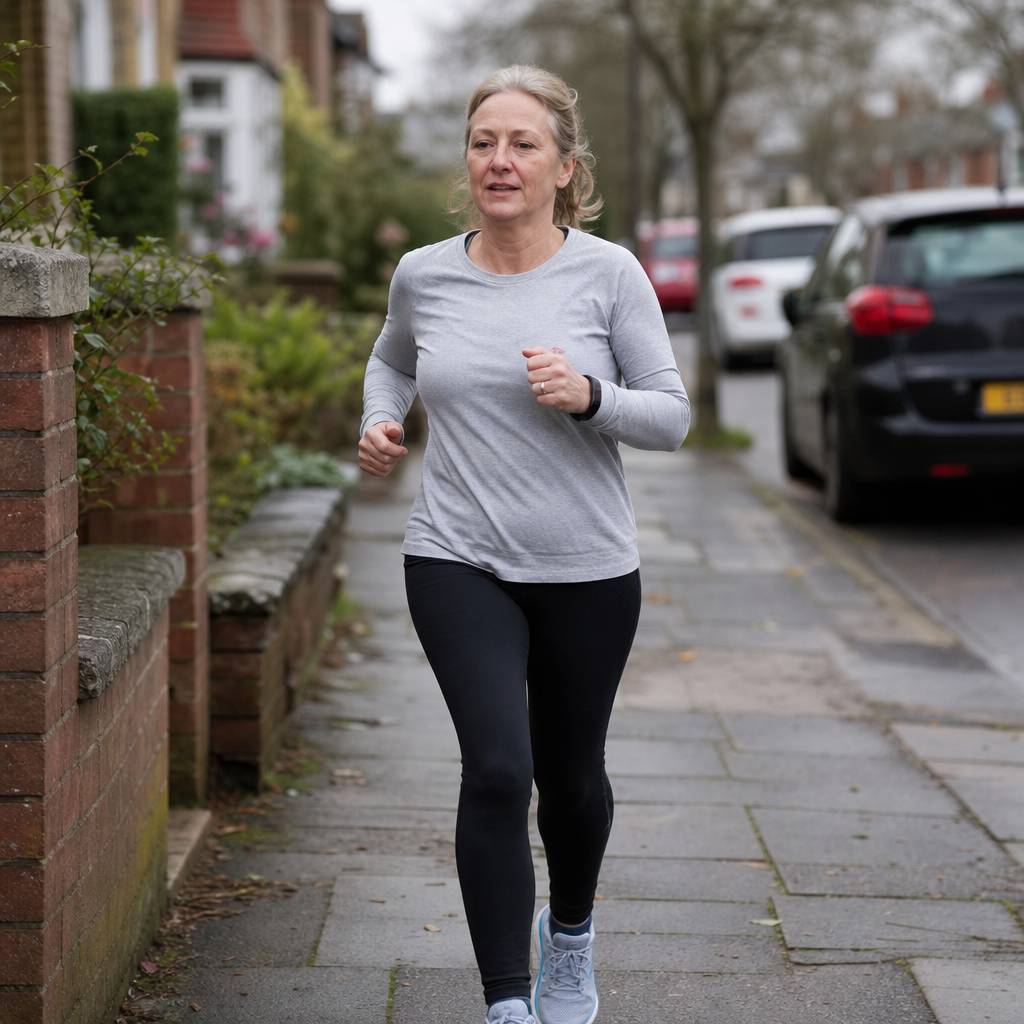
Start by walking. Brisk thirty-minute walks, two or three times a week, for a fortnight. This is not killing time until the running starts. It is building the base your joints will stand on, and skipping it is how people end up sore and discouraged by week three.
Then add the running in. A minute of running, two minutes of walking, repeated for twenty to thirty minutes, is a sound first structure. Hold each running minute slow enough that you could still talk. If you cannot finish a sentence out loud, you are pushing too hard. Ease off until you can.
Two or three sessions a week is plenty.
The rest days are not the gap between the work. They are where the work lands. Muscle, tendon and bone all rebuild stronger during recovery, not during the run itself, which is why piling on more too soon backfires. Add no more than roughly ten per cent to your weekly total from one week to the next.
If you are coming to this in your fifties or sixties, your body adapts on a slower clock than it did at thirty. Recovery simply takes longer now, and that is ordinary physiology, not a failing. Two rest days between sessions beats one in the early going. This is general information rather than medical advice, so if you have a heart condition, a joint problem, or any health worry, have a quick word with your GP before you start.
Where to run your first 5K
The easiest front door into running in the UK is parkrun. It is free, it happens at more than eight hundred locations every Saturday morning, and you are allowed to walk every step of the 5K (just over three miles). No qualifying time, no membership, no fee.
You register once online, print your barcode, and turn up. Marshals stand along the route, and you get a recorded time at the end whether you ran it, walked it, or did a bit of both. The over-fifties are one of the largest groups in the field most weeks, which catches out people who expect a start line full of whippets.
Walk the whole thing your first time. Almost everyone finds it gentler and friendlier than the version they had built up in their head.
Wet, cold mornings are the ones that talk you out of going, so knowing what to wear in British weather does more for your consistency than any training tip.
The mistake that ends most beginners
It is not injury that stops most new runners. It is not boredom or a lack of time either. It is running every session a little too hard.
A medium-hard effort feels like the honest, productive choice, so that is where most people settle. It is also the worst place to be. That pace is too hard to recover from comfortably and too easy to skip the big gains that genuinely hard efforts buy. Physiologists call it the grey zone. Everything aches, nothing gets easier, and after a month of it people quietly decide running is not for them.
It almost always was. They were just running it at the wrong speed.
Slower than feels right is, for a beginner, usually exactly right. The test never changes: if you can hold a conversation, you are going well; if you cannot, back off. The physiology behind running slowly explains why the easy pace is the one that, in the end, makes you faster.